Tiers
Undergraduate I
First-year university maths for science and engineering: many variables, linear algebra proper, probability with densities.
 III
0 of 26 26 to go
26 concepts
 Proof & Discrete Maths
How mathematicians know things are true, and the maths of whole numbers, choices and networks.
- Public-Key Cryptography (RSA)A way to let anyone lock a message that only one person can unlock, built on modular powers and the difficulty of factoring.Undergraduate I · Proof & Discrete Maths
- Graph TheoryThe mathematics of networks: points (vertices) joined by lines (edges), and what can be proved about paths, trees and colourings.Undergraduate I · Proof & Discrete Maths
- Limits Made RigorousWhat " gets as close as you like to " means exactly: every tolerance has a that guarantees it.Undergraduate I · Proof & Discrete Maths
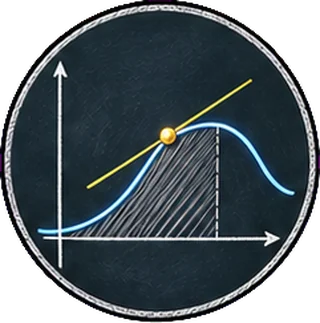 Functions & Calculus
Change and accumulation: the language of every science.
- Taylor Series and ApproximationWriting a smooth function as a polynomial built from its derivatives at one point, to approximate it and to see how it behaves nearby.Undergraduate I · Functions & Calculus
- Euler's FormulaThe identity , which joins exponentials, trigonometry and complex numbers into one idea.Undergraduate I · Functions & Calculus
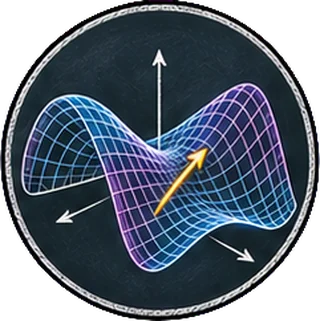 Multivariable & Vector Calculus
Calculus when things depend on many quantities at once, and fields that fill space.
- Partial Derivatives and the GradientDerivatives of a function of several variables, taken one variable at a time, and the gradient vector that collects them.Undergraduate I · Multivariable & Vector Calculus
- The Multivariable Chain Rule and JacobiansHow rates of change pass through functions of several variables, organised as a product of Jacobian matrices.Undergraduate I · Multivariable & Vector Calculus
- Multiple IntegralsIntegrals over areas and volumes, computed as repeated single integrals, with a Jacobian factor when changing coordinates.Undergraduate I · Multivariable & Vector Calculus
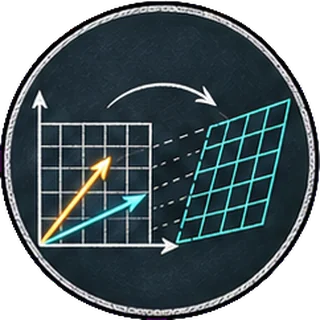 Linear Algebra
Vectors, matrices and the spaces they live in: the working language of AI and quantum mechanics.
- Vector Spaces, Basis and DimensionAny collection you can add and scale like arrows, measured by its dimension: how many independent directions it holds.Undergraduate I · Linear Algebra
- Eigenvalues and EigenvectorsThe directions a matrix only stretches and never turns, and the factor by which it stretches each one.Undergraduate I · Linear Algebra
- Orthogonality and ProjectionsPerpendicular vectors, and how to split any vector into a part inside a subspace and a part at right angles to it.Undergraduate I · Linear Algebra
- Least SquaresThe best approximate solution of a system with too many equations: the one whose errors have the smallest sum of squares.Undergraduate I · Linear Algebra
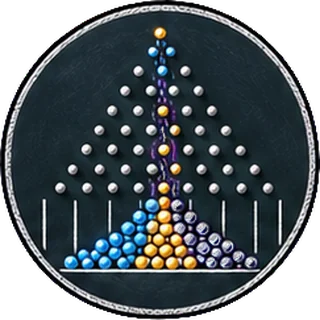 Probability & Statistics
Reasoning about uncertainty and learning from data.
- Probability DensitiesProbability for quantities that vary continuously, described by a density whose area over an interval is the chance of landing there.Undergraduate I · Probability & Statistics
- The Central Limit TheoremAdd up many independent random quantities and the total is close to normal, whatever each one's own distribution looks like.Undergraduate I · Probability & Statistics
- Joint Distributions and CovarianceHow two or more random quantities behave together, and covariance, which measures whether they tend to rise and fall together.Undergraduate I · Probability & Statistics
- Confidence Intervals and Hypothesis TestsTurning a sample into a statement about the whole population: a range of plausible values, or a test of a claim.Undergraduate I · Probability & Statistics
 Differential Equations & Fourier
How systems evolve in time, and how any signal is built from waves.
- Fourier SeriesWriting a periodic function as a sum of sines and cosines, with each coefficient found by an integral.Undergraduate I · Differential Equations & Fourier
- Second-Order Linear Equations and OscillationEquations with a second derivative, like , whose solutions oscillate, decay, or both: springs, circuits, pendulums.Undergraduate I · Differential Equations & Fourier
- Systems of Equations and Phase SpaceSeveral quantities changing together, , pictured as flows in phase space and solved with eigenvalues.Undergraduate I · Differential Equations & Fourier
 Physics
Mechanics, waves, fields and relativity: the physics quantum mechanics grew out of.
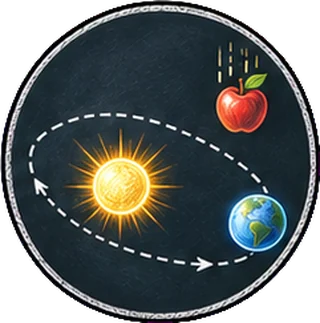
- Gravity and OrbitsNewton's inverse-square law of gravity, and how it produces circular and elliptical orbits, orbital speeds and escape velocity.Undergraduate I · Physics
- Simple Harmonic MotionMotion under a restoring force proportional to displacement, , which oscillates as a sine wave with a fixed period.Undergraduate I · Physics
- Waves and InterferenceA disturbance that travels while each point only oscillates; when waves overlap their displacements add, giving interference.Undergraduate I · Physics
- Photons and the Photoelectric EffectLight comes in packets of energy ; the photoelectric effect shows one photon frees one electron, whatever the light's brightness.Undergraduate I · Physics
 Optimisation & Information
Finding the best, and measuring surprise: the two ideas training a model rests on.
- Information and EntropyEntropy measures the average surprise of a random outcome, in bits: the shortest average code length.Undergraduate I · Optimisation & Information
- Optimisation in Many VariablesFinding the highest and lowest points of a function of several variables: where the gradient is zero, sorted by the Hessian.Undergraduate I · Optimisation & Information
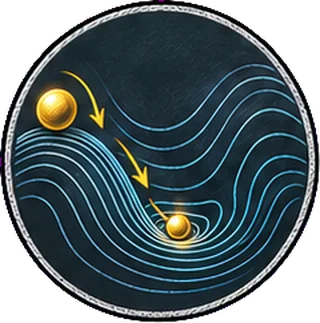
- Gradient DescentRepeatedly stepping against the gradient, , to walk downhill towards a minimum.Undergraduate I · Optimisation & Information