Tiers
Undergraduate II
The second year: the spectral theory, transforms, optimisation and probability that modern AI and physics are written in.
 IV
0 of 26 26 to go
26 concepts
 Proof & Discrete Maths
How mathematicians know things are true, and the maths of whole numbers, choices and networks.
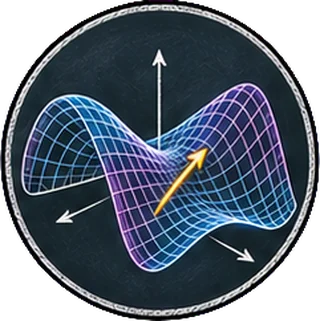 Multivariable & Vector Calculus
Calculus when things depend on many quantities at once, and fields that fill space.
- Divergence and CurlFor a field of arrows, such as a flow or a force, divergence measures spreading out from a point and curl measures swirling.Undergraduate II · Multivariable & Vector Calculus
- The Theorems of Gauss and StokesTwo theorems saying that what happens inside a region adds up to what crosses its boundary: divergence to outward flux, curl to circulation.Undergraduate II · Multivariable & Vector Calculus
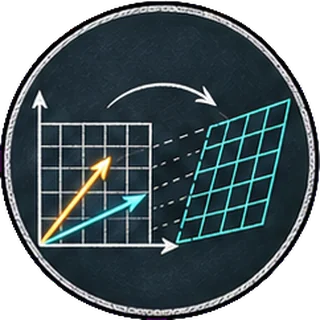 Linear Algebra
Vectors, matrices and the spaces they live in: the working language of AI and quantum mechanics.
- Tensor ProductsA way of combining two vector spaces into one whose dimension is the product of theirs: the space of a joint system.Undergraduate II · Linear Algebra
- The Spectral TheoremEvery real symmetric matrix has real eigenvalues and perpendicular eigenvectors, so it is just stretching along perpendicular axes.Undergraduate II · Linear Algebra
- Complex Inner Product SpacesLengths and angles for vectors with complex entries, where the inner product conjugates one side so that lengths stay positive.Undergraduate II · Linear Algebra
- Singular Value DecompositionEvery matrix, of any shape, is a rotation, then a stretch along perpendicular axes, then another rotation.Undergraduate II · Linear Algebra
- Hilbert Spaces and OperatorsVector spaces whose vectors are functions, with an inner product given by an integral, and the linear operators that act on them.Undergraduate II · Linear Algebra
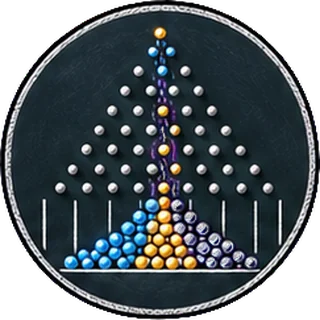 Probability & Statistics
Reasoning about uncertainty and learning from data.
- Markov ChainsA random process hopping between states, where the next step depends only on the current state and not on how it got there.Undergraduate II · Probability & Statistics
- Maximum LikelihoodEstimating a model's parameters by choosing the values that make the observed data most probable.Undergraduate II · Probability & Statistics
- Bayesian InferenceTreating an unknown parameter as uncertain: give it a prior distribution and update it with data by Bayes' theorem.Undergraduate II · Probability & Statistics
- The Multivariate NormalThe bell curve in many dimensions, set by a mean vector and a covariance matrix, with elliptical contours.Undergraduate II · Probability & Statistics
 Differential Equations & Fourier
How systems evolve in time, and how any signal is built from waves.
- The Fourier TransformThe Fourier series for functions that never repeat: any signal becomes a continuous spread of frequencies.Undergraduate II · Differential Equations & Fourier
- The Wave and Heat EquationsEquations for quantities that vary in both space and time: heat spreading out, and waves travelling along a string.Undergraduate II · Differential Equations & Fourier
- Nonlinear Dynamics and ChaosSystems whose laws are simple and exact yet whose futures cannot be predicted far ahead, because tiny differences grow exponentially.Undergraduate II · Differential Equations & Fourier
 Physics
Mechanics, waves, fields and relativity: the physics quantum mechanics grew out of.
- Special RelativityFrom two postulates, the same physics and the same speed of light for every steady observer, time and length depend on motion.Undergraduate II · Physics
- Statistical Mechanics and EntropyTemperature, heat and entropy explained by counting microscopic states: each state of energy has probability proportional to .Undergraduate II · Physics
- Lagrangian and Hamiltonian MechanicsMechanics rewritten from energies: the path a system takes makes the action stationary, and the Hamiltonian evolves positions and momenta.Undergraduate II · Physics
- Maxwell's EquationsFour equations for how electric and magnetic fields are made by charges and currents and how each field's change creates the other.Undergraduate II · Physics
 Optimisation & Information
Finding the best, and measuring surprise: the two ideas training a model rests on.
- ConvexityA function is convex if the chord between any two points on its graph lies above it; then every local minimum is global.Undergraduate II · Optimisation & Information
- Lagrange MultipliersOptimising under a constraint: at the best point, the gradient of the function is a multiple of the constraint's gradient.Undergraduate II · Optimisation & Information
- Cross-Entropy and KL DivergenceCross-entropy measures how many bits a model needs to describe data really drawn from ; KL divergence is the excess over the minimum.Undergraduate II · Optimisation & Information
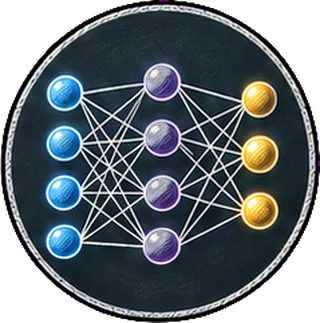 Machine Learning
How a program learns from examples, from a fitted line to a transformer.
- Linear Regression as LearningFitting by choosing the parameters that minimise the mean squared error: the simplest model that learns from data.Undergraduate II · Machine Learning
- Principal Component AnalysisFinding the directions along which data varies most: the top eigenvectors of its covariance matrix, used to compress and visualise data.Undergraduate II · Machine Learning
- Logistic Regression and ClassificationA linear score passed through the sigmoid to give a probability, trained by minimising cross-entropy.Undergraduate II · Machine Learning
- Overfitting and RegularisationA model that fits its training data too closely does worse on new data; regularisation trades a little training fit for better generalisation.Undergraduate II · Machine Learning